
Material guide to poly(butylene adipate-co-terephthalate) and the films made from it.
Definition
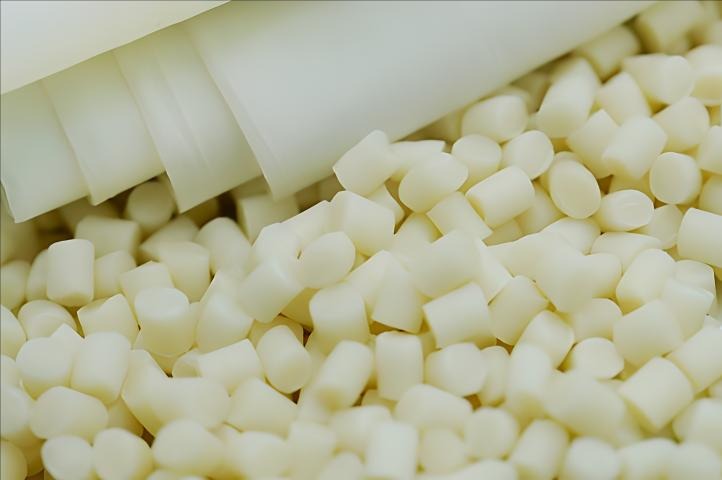
PBAT stands for poly(butylene adipate-co-terephthalate), a synthetic copolyester identified by CAS number 55231-08-8. It belongs to the family of aliphatic-aromatic polyesters and is supplied as pellets that can be melted and formed into film on conventional extrusion equipment.
The material was developed to combine two properties that rarely occur together: the flexibility and toughness expected of a polyolefin film, and the ability to biodegrade under composting conditions. That combination is why PBAT has become a reference resin for compostable flexible packaging and agricultural film.
When a specification says PBAT film, it may mean pure PBAT or a compound with PLA, starch or biomass-balanced feedstock. The resin base should always be stated, because it determines stiffness, sealing behaviour and the end-of-life route.
Chemistry
PBAT is produced by polycondensation of three building blocks: adipic acid (AA), terephthalic acid (PTA) or its dimethyl ester, and 1,4-butanediol (BDO). Adjusting the ratio of the two acid units changes the balance between flexibility and strength.
Adipate units are flexible and lower the glass transition temperature. They give the film elongation, softness and the chain sections most readily attacked in the first stage of biodegradation.
Terephthalate units add tensile strength, heat resistance and dimensional stability. They allow thin gauges to be drawn without tearing and keep the film stable during converting.
Reference Properties
Values below describe a typical film-grade PBAT resin and are given with the test method so that supplier data can be compared on the same basis. They describe the resin, not a finished multilayer structure.
End of Life
Biodegradation begins when water and microbial enzymes attack the ester bonds along the polymer chain, breaking it into smaller molecules. Microorganisms then consume those fragments and convert them mainly into carbon dioxide, water and new biomass.
The process depends on the environment. Industrial composting provides the temperature, moisture and aeration that certified compostable films are designed for. A film certified for industrial composting should not be assumed to break down quickly in home compost or in soil; soil biodegradable grades are assessed separately and must be specified for agricultural use.
Standards such as EN 13432 and ASTM D6400 cover biodegradation, physical disintegration, heavy metal limits and ecotoxicity of the resulting compost. A compostable claim is meaningful only when it names the standard and the disposal environment.
Read the Science ExplainedComparison
The three materials are often compared, but they answer different design needs. The table below describes typical film behaviour rather than absolute values.
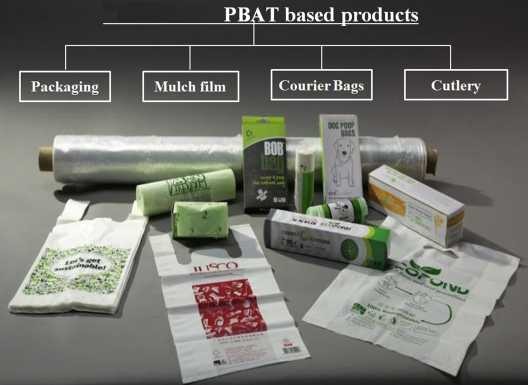
Flexible and tough with high elongation. Biodegradable under composting conditions, with soil biodegradable grades available. Processed by blown and cast film extrusion. Suited to bags, mulch, cling and stretch film.
Stiff and clear with good printability, but comparatively brittle. Derived from fermented plant sugars and generally requires industrial composting. Often blended with PBAT to improve toughness.
Tough, low cost and widely recycled where collection exists, but not biodegradable. Serves the same formats as PBAT film without an organic end-of-life route.
Processing
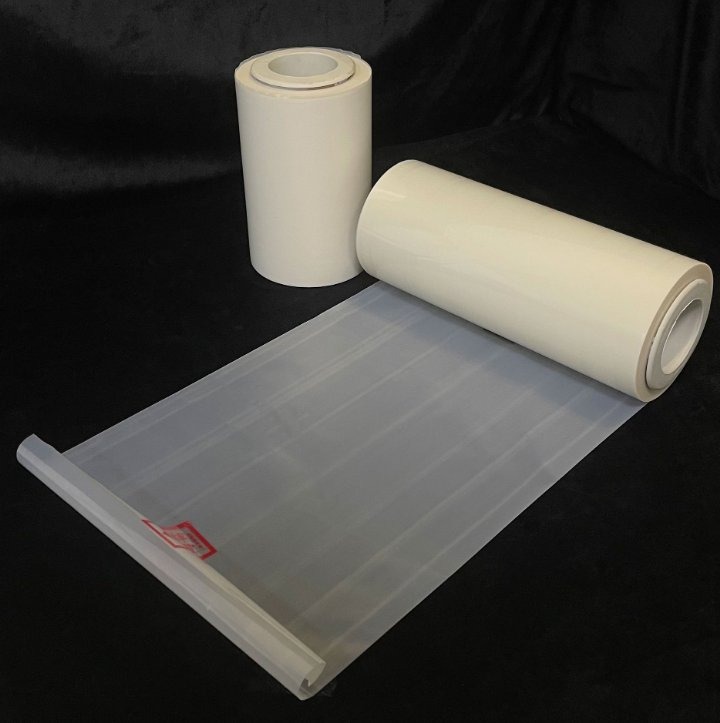
PBAT film is made by melting the compound and forming it through a blown film tower, a cast film line, an extrusion coating die or a melt-blown head. Temperature profiles are set to protect the polymer phase, and blends containing PLA are usually dried before extrusion.
The resulting film runs through bag making, thermoforming, lamination or pallet wrapping equipment already installed at a converter. That drop-in behaviour is a practical reason specifiers move conventional film volumes to PBAT based grades.
Explore the 25 GradesFAQ
No. PBAT is flexible and tough; PLA is stiff and brittle. They are frequently blended so the final film combines stiffness with tear resistance.
Only if the specific grade is certified for that environment. Industrial compostability does not automatically extend to a garden compost pile.
Compostable film should be kept out of conventional plastics recycling, where it can contaminate the stream. Follow the route named on the grade certification.
Pure PBAT and PBAT and PLA blend grades are listed separately on every model page, together with gauge, process route and format.
 +8618112911328
 sales1@liwei-chem.com
 +8618112911328
 Yuna Yang
 Scan to WhatsApp
